2027 Fingerprint Technology Trends: From Static Params to Behavioral Fingerprints
Last month, a friend who runs cross-border online stores came to me to review his accounts. His residential proxies were all set up, Canvas, WebGL, and UA passed every check on the testing sites, and the IP location matched the time zone perfectly — yet on day three, the accounts still got locked out of login. Nothing wrong could be found at the parameter level, so the reason had to be somewhere deeper.
Cases like this have become far more common over the past year, because risk engines are shifting their judgment from "what you claim to be" to "how you act". Device and data isolation can be handed to a dedicated environment-isolating antidetect browser, but to deal with what happens at the behavior layer, you first have to understand it. This article explains why static params stopped working, and what the "behavioral fingerprint" taking over from them actually is.
Why a Clean IP and Perfect Params Still Get You Blocked
Back to my friend's case, and let's break down where he slipped. His environment passed every technical check; the real problem came down to three things. Some of his actions were run by scripts on a fixed schedule, with nearly identical gaps between operations. He kept six environment windows open side by side, and several accounts produced highly similar action sequences within the same minute. And the new environment went from registration to the ads dashboard in just two hours, with almost no usage history behind it.
None of those three things belongs to the "parameter" category. Risk engines classify them as behavioral signals: the rhythm of your operations, how synchronized multiple environments are, and the growth trajectory of an account. In its 2026 analysis of bot detection frameworks, Thunderproxy groups signals into devices, network, behavior, and cross-layer consistency, with the behavior group's weight climbing steadily. Device and data isolation can be handed to MostMate's environment isolation solution, but the behavior group plays out outside the isolated environment.
So here is the frequent question in "browser fingerprint detection" discussions: with a clean residential or mobile proxy in place, why do accounts still get blocked? The answer hides in the limits of what a proxy can do — it only changes the connection source at the network layer. It has no say over how your mouse moves, whether your typing rhythm is even, or whether several environments do the same thing in the same second. A proxy hides "where you connect from"; it cannot hide "what you do after connecting". Today's mainstream behavioral fingerprinting targets exactly the second half.
Why Tweaking Params Matters Less and Less
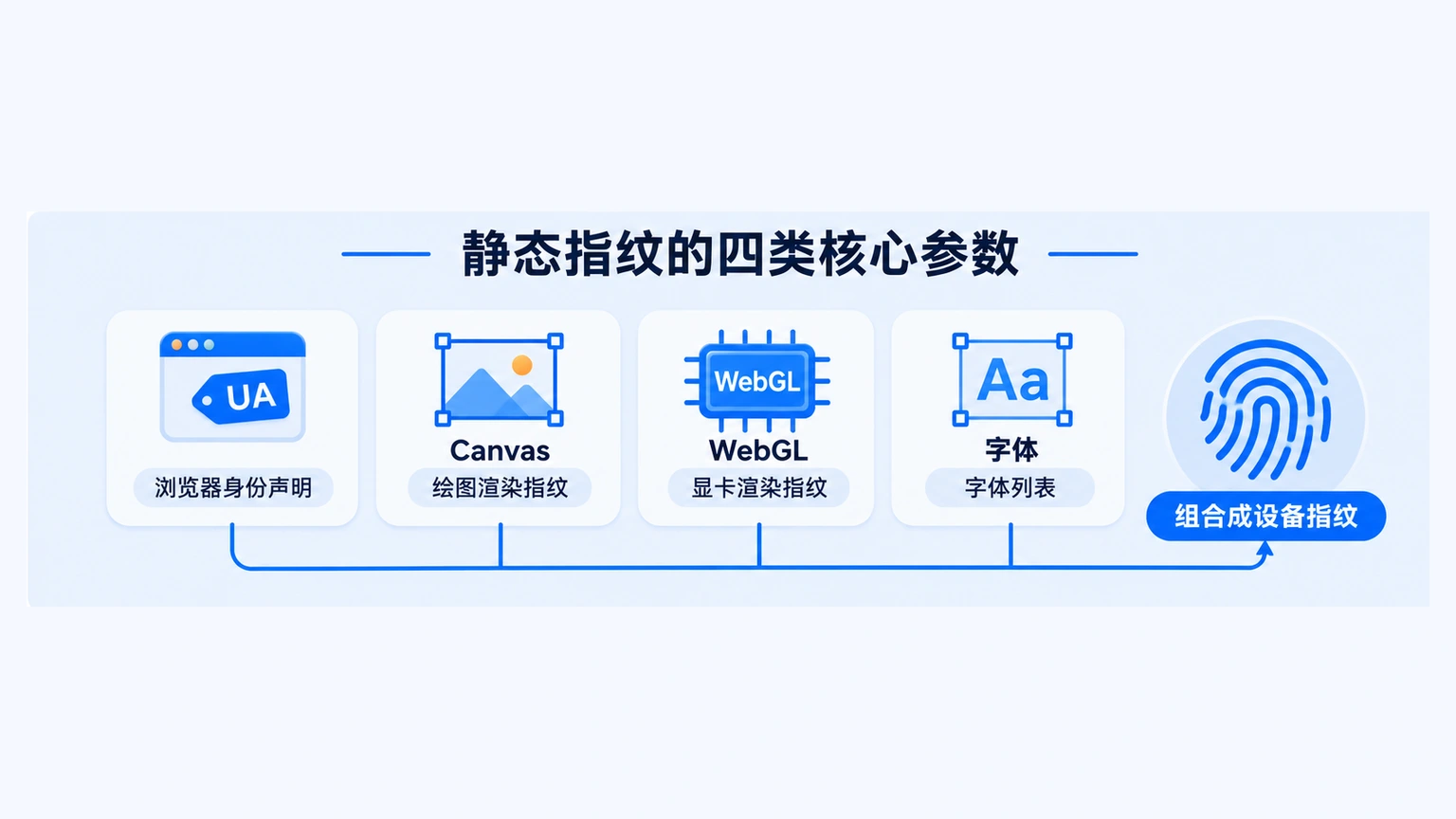
To understand this shift, start with the term "device fingerprint". What is a device fingerprint? In plain words: it is a set of hardware and configuration traits your browser reports about itself — screen resolution, GPU model, font list, OS version. Websites can read these without asking permission, and combined, they are enough for device fingerprinting to tell different machines apart.
Over the past few years, the parameter-level arms race has swung back and forth. Early detection worked like airport security: any param outside the normal range got flagged. Once antidetect browsers spread, the cost of faking params dropped to nearly zero, and detectors changed tactics. In its analysis of machine-learning risk control, Spoofbrowser splits this evolution into three stages: rule-based filtering first, then hybrid models that weighted multiple signals, and now mainstream models that learn "what a normal human looks like" directly from massive real-user data.
So faking params keeps getting easier while spotting faked params keeps getting harder — and detectors simply moved to where params cannot reach: down into the protocol layer, and up into the behavior layer.
What Is a TLS Fingerprint?
Before a website loads, the browser and the server complete an encrypted handshake to agree on how they will talk. The algorithm lists, extension order, and parameter values inside the handshake act like a person's accent — you can rehearse what you say, but your accent is hard to change on the spot. Encode that combination into a short identifier, and you get a TLS fingerprint: the "accent" your browser exposes during the handshake.
From JA3 to JA4: Why the Old ID Got Replaced
After Chrome added randomization to some handshake parameters, the old JA3 ID became unstable. The upgraded JA4 fingerprint strips out the randomized parts, making identification stable again, and it has since been adopted by infrastructure vendors like Cloudflare.
Two New Signal Sources to Watch in 2027
One is the SETTINGS frame order at the HTTP/2 layer. The low-level configuration frames a browser sends when opening a connection are ordered differently by each vendor — another "accent" being written down.
The other is post-quantum TLS fingerprinting. To resist quantum computing, browsers are enabling new key-exchange algorithms, and those parameters naturally become a new fingerprint source — Proxies.sx lists it as a new member of the six-layer signal stack in its 2026 fingerprinting stack review.
Can a TLS fingerprint be spoofed? Mechanically speaking, any library or patch that alters handshake parameters leaves new inconsistencies elsewhere — the browser version claims to be one client while the handshake says another, landing squarely in the "cross-layer contradiction" zone that risk engines watch.
What Is a Behavioral Fingerprint?
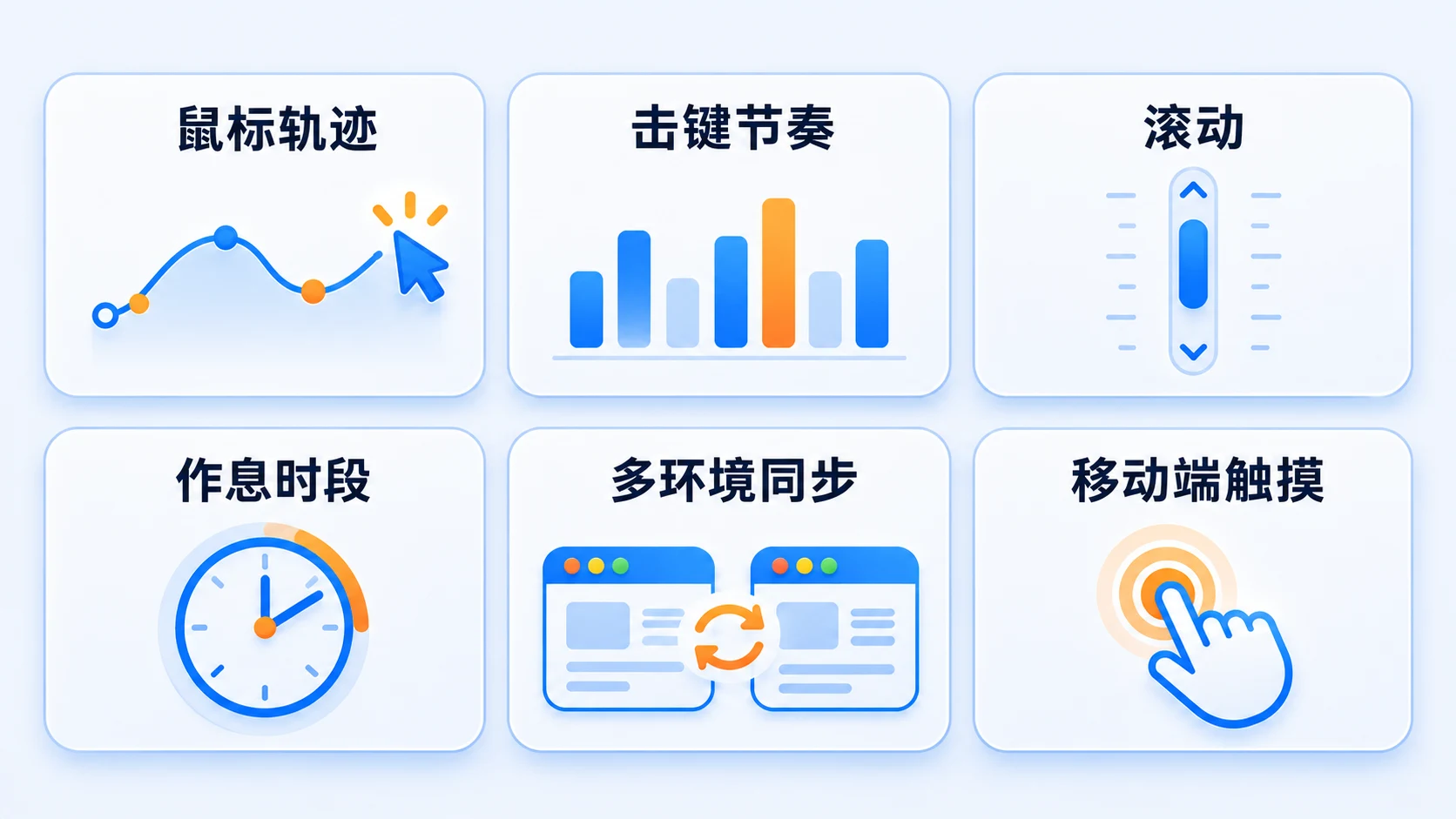
A behavioral fingerprint is the sum of the action traits you leave while using a page: how the mouse moves, how the keyboard is hit, how the page scrolls, how long you linger on each element. Parameter fingerprints answer "who does this device claim to be"; behavioral fingerprints answer "what does the person at the keyboard actually do". The former can be configured; the latter has no settings to tweak — it only forms naturally through real, accumulated use.
1. Mouse Trajectory
Human mouse movement carries curves, acceleration, and micro-jitter; script-drawn paths tend to be too straight and unnaturally uniform in speed. One of the judgment criteria is whether the motion obeys human motor rules — the farther and smaller the target, the slower a real hand arrives. No real operation escapes that constraint.
2. Keystroke Dynamics
How long you hold a key and the gap between keystrokes differ from person to person and stay remarkably stable over time. Risk engines do not care what you type — only whether the rhythm looks human and matches the account's past behavior.
3. Scrolling, Dwell Time, and Mobile Touch
Beyond the desktop, scrolling speed, dwell time, and on mobile the touch pressure and sensor signals are all common ingredients in behavioral fingerprint detection. The checklist risk engines watch looks roughly like this:
- The shape, speed, and micro-jitter of mouse trajectories
- Keystroke rhythm: the distribution of hold times and key gaps
- Scrolling speed and dwell-time distribution
- Active hours and daily activity curves
- How synchronized actions are across multiple environments
- Mobile touch pressure and sensor signals
How Do Risk Engines Score? Reading the Layers Together
Behavioral signals are never used alone. In 2026, mainstream risk engines feed devices, network, params, and behavior into one scoring model — behavioral traits are just one input, and judging on them alone distorts the picture. Spoofbrowser's reverse estimation of two mainstream commercial risk products puts the signal weights roughly as follows (estimates for understanding the structure, not precise figures):
| Signal group | Weight estimate | What it judges |
|---|---|---|
| IP vs. declared region alignment | ~20% | Whether the proxy location matches the time zone, language, and billing address |
| Network-layer traits | ~18% | Whether TLS and HTTP/2 fingerprints match the browser's claims |
| Browser params | ~15% | Whether Canvas, WebGL, fonts, and so on are self-consistent |
| Behavioral traits | ~15% | Whether mouse, keyboard, and scrolling look human |
| Cross-signal consistency | ~12% | Whether the layers corroborate each other |
| Everything else | ~20% | Historical reputation, account age, content traits, and more |
The point of the table is not the exact numbers but the structure: a perfect score on one layer cannot rescue a cross-layer contradiction. The UA claims a Windows device, the TLS handshake looks like another kind of client, and the behavior rhythm is as even as a metronome — the deductions land on "they contradict each other". That also answers another frequent question: which detection signals carry the most weight now? Cross-layer consistency, not any single parameter.
Enforcement is changing too. TrueSight and TR7 point to the same trend in their bot management analysis: scoring engines are shifting from blanket blocking to dynamic challenges — low risk passes straight through, medium risk gets a CAPTCHA or throttling for observation, and only high risk gets banned. That means many "blocks" actually happen in the medium band: the account is not dead, but every challenge eats your time.
What Should Multi-Account Operators Watch in 2027?
At the operational level, the trend comes down to three things:
- Leave key actions to humans: logins, profile changes, and anything money-related should be done by hand; scripts only handle low-risk, read-only queries.
- Avoid mechanical sync: do not run identical action sequences across environments in the same time window; stagger schedules and pacing.
- Build history for new environments: accumulate real usage traces after registration before moving into high-value operations.
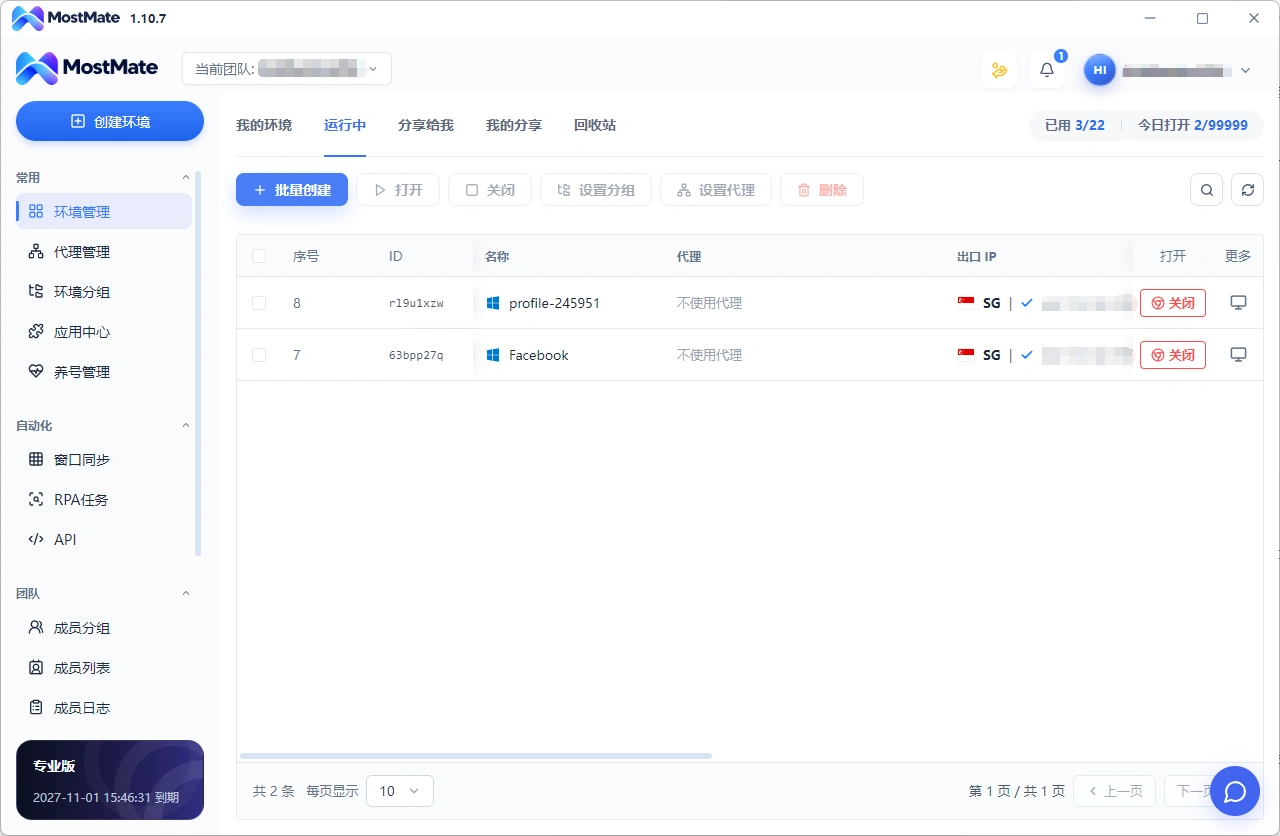
An environment-isolating browser handles the device and data layers: independent params per environment, fingerprints that stay stable over time, and cookies and sessions that never bleed into each other. MostMate's multi-account environment management platform ships those isolation capabilities as the default state when you create a new environment. But the behavior layer has no settings to flip — it comes from how you operate, and only discipline covers it. The division of labor is clear: tools set the floor (environments do not pollute each other), operations set the ceiling (behavior does not look batch-produced).
Behind the search phrase "antidetect browser detected", the anxiety is usually not a broken tool but a leak at the behavior layer — with the bill charged to the tool. Separating the device layer from the behavior layer is what makes attribution accurate and the response targeted.
How Can Regular Users Reduce Fingerprint Tracking?
Everything above took the operator's view; this section flips to the privacy side and asks what a regular user who does not want to be tracked can do. The way browser fingerprint tracking works means it cannot simply be switched off — reading traits requires no storage on your device, so there is nothing to delete. But you can lower how identifiable you are:
- Firefox users can enable privacy.resistFingerprinting (search for it in about:config); the browser then presents near-identical params to every site.
- For scenarios that demand strong anonymity, use the Tor browser, which standardizes every user's browser traits into one uniform set.
- Cut browser extensions and tighten permissions to shrink the trait surface websites can read.
Keep in mind that these measures serve personal privacy, which is a different goal from multi-account operations — the former wants to blend into the crowd, the latter wants each environment independent and stable. Mixing the two disappoints on both ends.
Wrapping Up
Think of static params as the entry ticket and behavior as the interview. You can buy the ticket; the interview is yours alone to pass — that is the real relationship between risk engines and operators in 2027.
Next time you hit "params are perfect but still blocked", run a fingerprint testing site first to clear the device layer, then honestly audit the behavior layer — are action intervals too regular, are several environments synced too neatly, is a brand-new environment jumping straight into high-value operations. Once your tool has isolation right, the remaining points are earned back one day of disciplined operations at a time.
FAQ
Can mouse trajectories and keyboard input be detected too?
Yes. Page scripts can record the shape and speed fluctuations of your mouse path, plus the timing of key presses and releases. Each person's action patterns stay stable over time, which is one basis for telling humans from automation and one operator from another.
Why are behavioral fingerprints becoming more important?
Since antidetect browsers spread, the cost of faking static params has dropped to nearly zero, so detectors shifted weight to the behavior and protocol layers beyond params' reach. Machine-learning models also need behavioral data to define what counts as "normal".
Why do clean IPs still get blocked?
A proxy only changes the network-layer connection source; it cannot govern operation rhythm, multi-environment sync, or account growth. Behavioral traits and cross-layer consistency now outweigh IP quality alone in scoring models.
Which detection signals carry the most weight now?
Cross-layer consistency. Any single signal can be faked in part, but getting devices, network, params, and behavior to corroborate each other is hard — and contradictions are exactly where risk engines deduct points.

MOSTMATE
Secure Multi-Account Management, Made Simple
Start with your first account and use MostMate to build safer, smarter, and more efficient multi-account operations.
- Independent profiles. Consistent identities.
- AI Automation · Account Health · Team Operations