Etsy Multi-Shop Anti-Association Guide: Separate Environments, Accounts, and Networks
Core takeaway: Etsy officially allows one person to run multiple shops, and it also asks you to list every shop you own in your public profile; the real association pressure sits not with payment details but with three lines: login environments, network exits, and selling behavior. What needs doing is decided before you open a shop, so this guide walks through it in the order you would open one.
Once a shop selling handmade goods, vintage items, or printables takes off, splitting product lines, testing new designs, and isolating business risk all point toward a second shop. The trouble follows soon after. One seller registered two accounts on the same computer on the same day, and the login records of the two shops have grown together ever since, which makes any appeal painfully hard. MostMate is an AI fingerprint browser that gives every account its own browser environment. How to divide environments across shops and how to run them day to day is covered below, in order.
Start with the official rules: multiple shops are allowed, as long as you say so openly
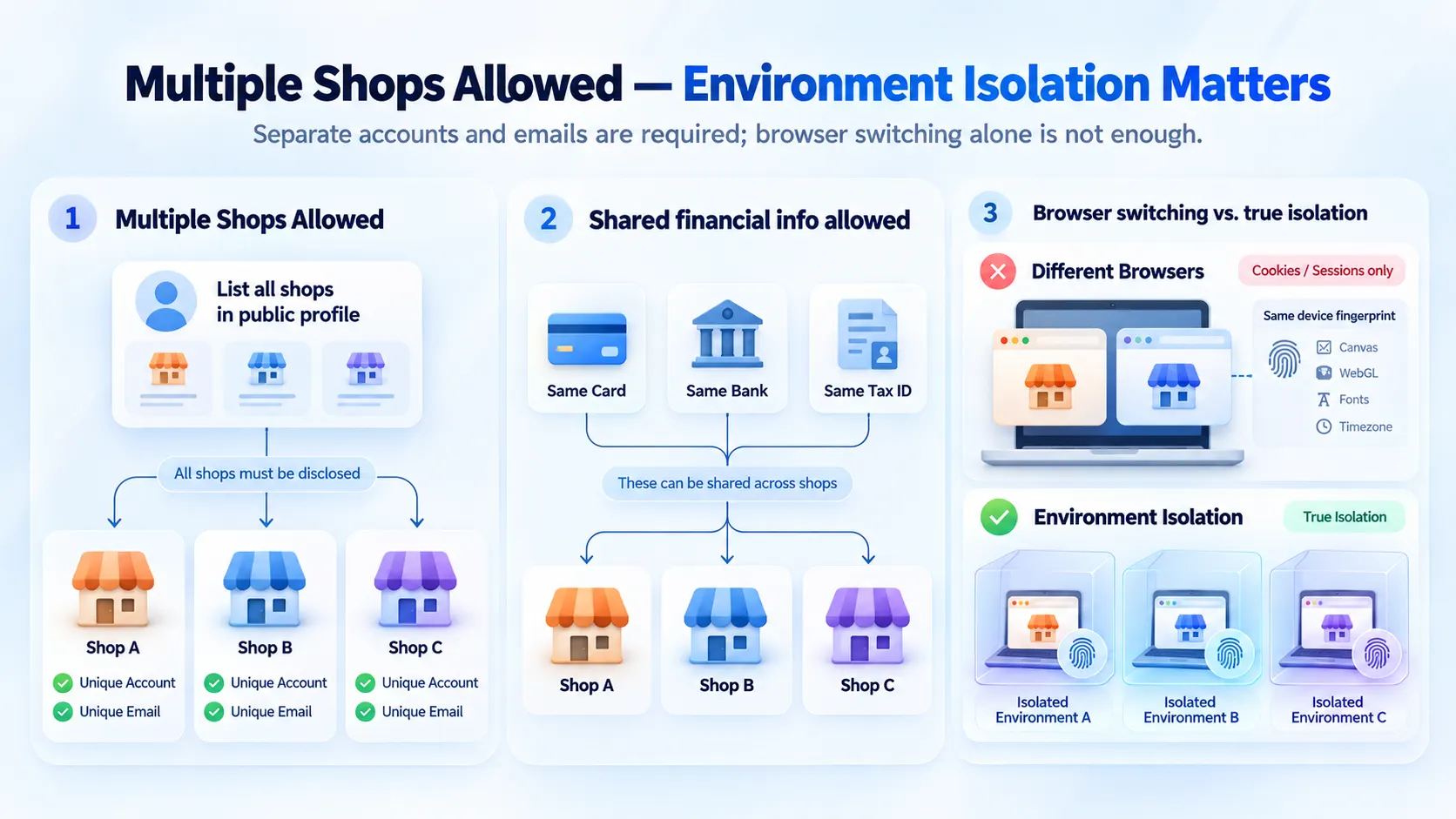
Etsy's stance on multiple shops is out in the open; the rules sit right in the Help Center. Running several shops at once is officially allowed. The condition is that each shop gets its own Etsy account tied to an email address not used on any other shop. One requirement is easy to overlook: choose to run multiple shops, and you must list all of the shops you own in each account's public profile. This is a compliance requirement, not an optional extra.
On payment details the official position is equally clear. Sellers may register with the same credit card. Once Etsy Payments is enabled, the same bank account can also be used across multiple shops. Your taxpayer ID must be consistent where applicable. The claim that "same card and same payout account means automatic linkage," which circulates in Chinese-speaking seller communities, does not hold up against the official rules.
Another official suggestion is often dismissed as a minor point: multi-account sellers should use a different browser for each account to skip the hassle of logging in and out. That sentence deserves a closer read. What the official guidance solves is "don't log into the wrong account," but different browsers only separate cookies and sessions. Device-level fingerprints such as Canvas, WebGL, fonts, and time zone still live on the same machine. EFF's fingerprinting project Cover Your Tracks ran live tests on visitors and found that most browsers carry a unique fingerprint combination; switching browsers does not change that layer.
True isolation has to happen at the environment level: fingerprints, cookies, and proxies each kept apart.
The risk is not in your payment account, it is in three other lines
Etsy has never published the exact criteria it uses to link accounts; what can be confirmed is that the pressure concentrates on three types of signals.
- First, login environments. Logging into several shops in turn on the same device stacks fingerprints and session records on top of each other. The official suggestion to use different browsers shows that crossed logins are a hassle the official guidance expects. But a browser only separates so much; the device fingerprint remains.
- Second, network exits. Multiple accounts logging in from the same IP for months stands out even more when that IP carries datacenter traits. A home broadband line can change plans without changing its exit, and multiple shops still share one route.
- Third, selling behavior. Two shops selling nearly identical listings, reviewing each other's orders, and sharing the same descriptions and materials. Once this kind of activity triggers a review, all of your shops get looked at together. The buyer-trust clauses and duplicate-listing limits in the Seller Policy are exactly what such reviews rest on.
Being looked at together does not mean action is certain. Enforcement comes in tiers: delisting, suspension, and permanent closure are all possible. Once a case reaches the appeal stage, though, the odds are rarely good. This is where anti-association work matters: take apart the preventable signals early instead of inviting a manual review yourself.
Before opening a shop: one shop, one environment
Build the environment before you register an account, not after.
Get the order wrong and isolation starts a step late. In MostMate, create an environment per shop: one shop, one environment. The flow has four steps; if you have not installed it yet, check the four-step setup preview on the homepage.
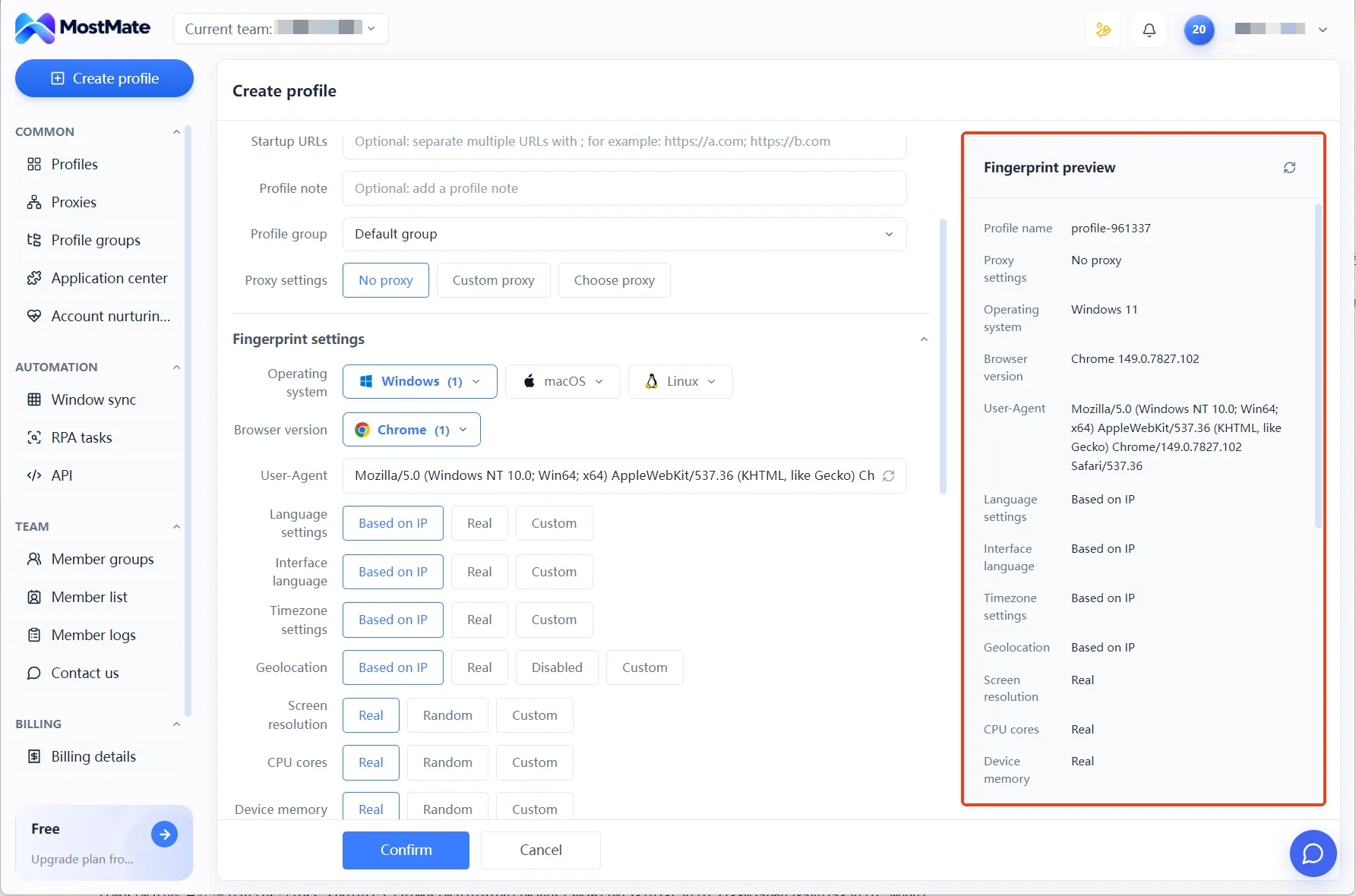
1. Create the environment and pick the operating system and browser version. The recommended configuration generates a full set of fingerprint parameters, with language, time zone, and geolocation aligned automatically to the proxy IP.
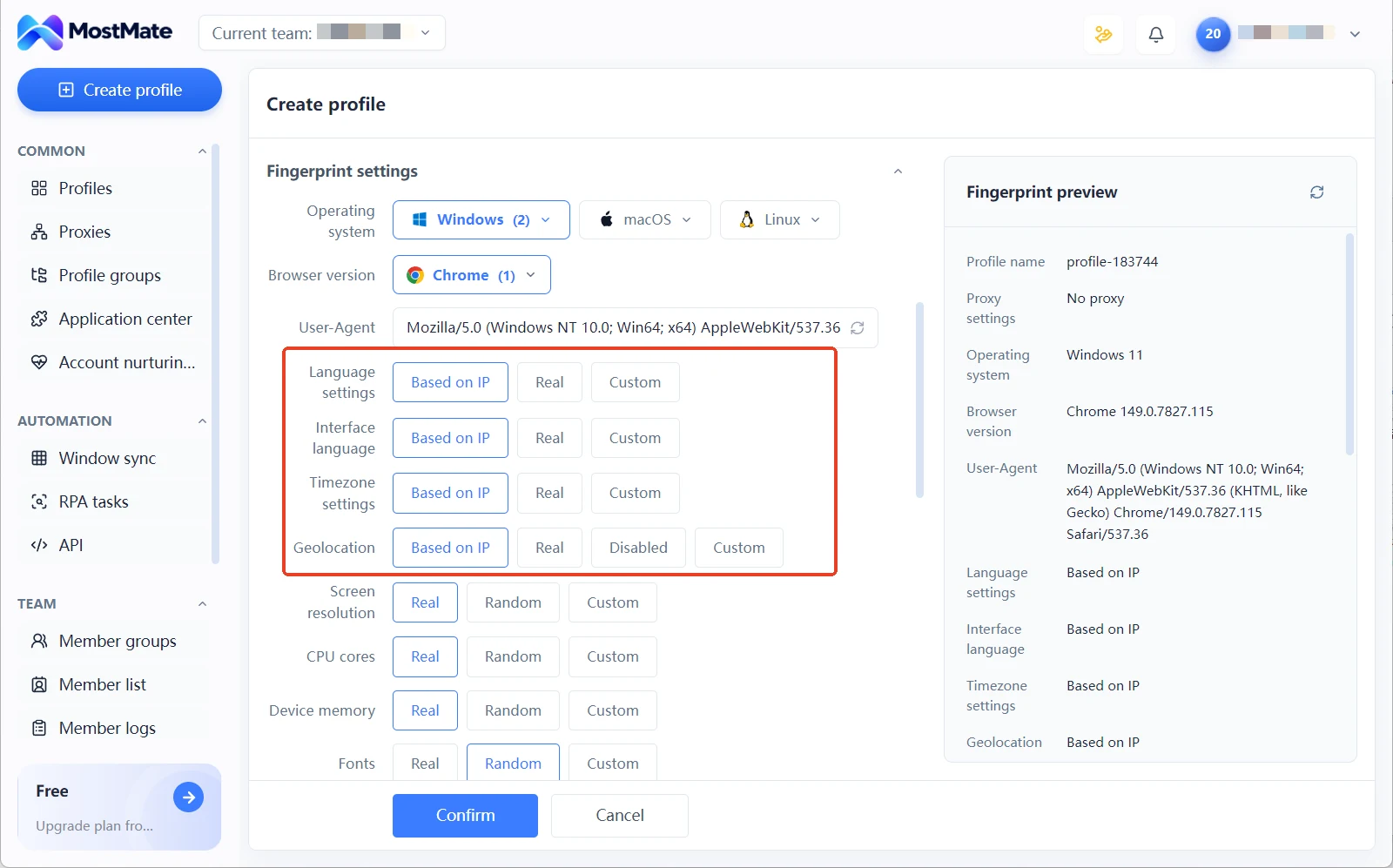
2. Add a proxy in the proxy list and test the connection; HTTP, HTTPS, SOCKS5, and SSH are all supported, and a tested proxy can be assigned to an environment.
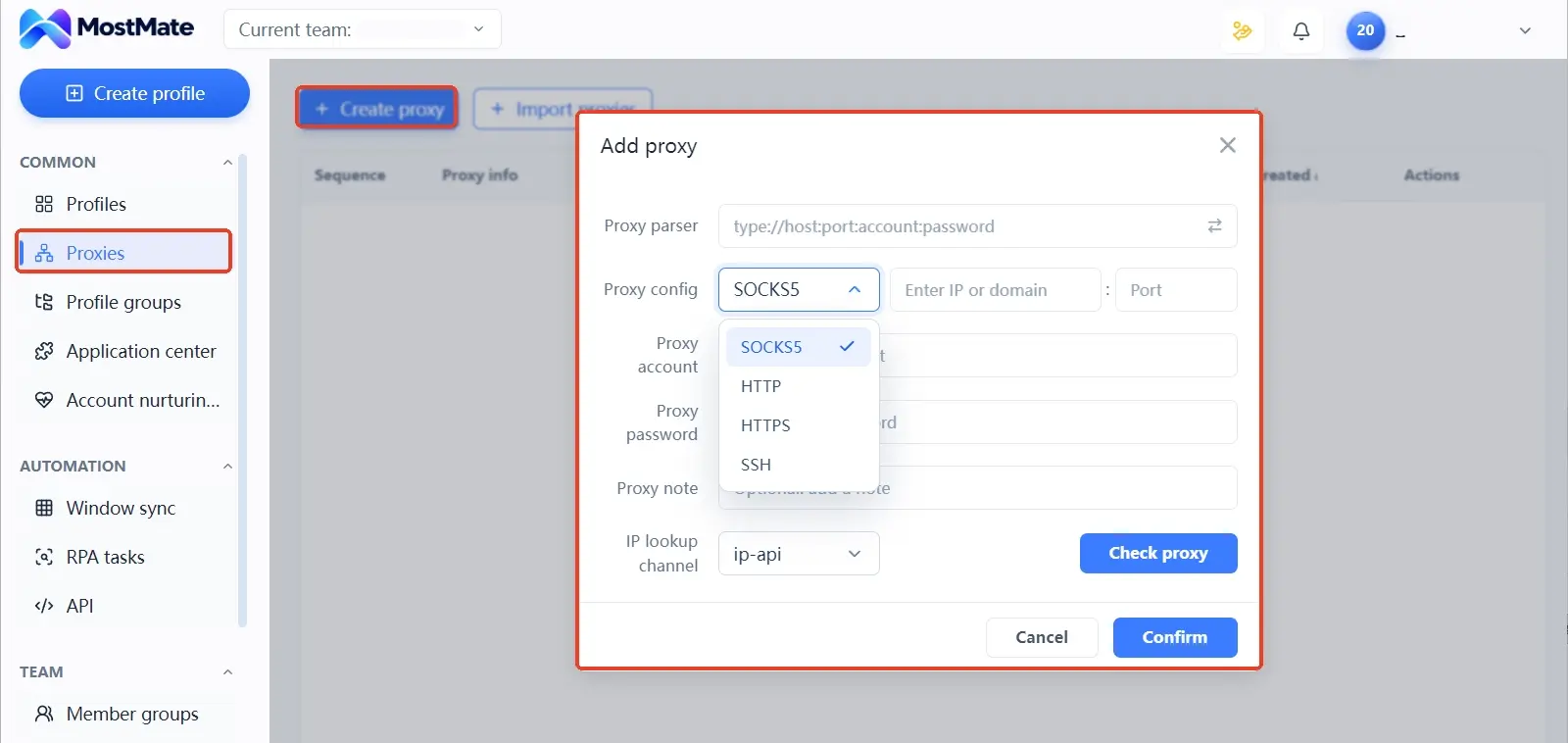
3. For multiple Etsy shops, give each shop its own residential exit. Datacenter IPs get flagged easily in e-commerce; how to choose between the two types is covered by business stage in fixed IP vs. dynamic IP: choosing by stage.
4. Open the fingerprint preview panel to check the values, confirm that time zone, language, and IP location match, then use this environment to register the account and open the shop.
Day-to-day management stays easy afterwards. Group environments by shop or category, and switch between shops entirely inside their own environments so login states never touch. How environments and fingerprint parameters work together is fully explained on the MostMate product page. One detail is easy to miss: open confirmation emails and platform notifications inside the matching environment. Click one in your local browser and the boundary of that environment cracks a little. Only the environment itself can patch that layer.
During operations: make each shop read like a different person
Once environments are separated, daily habits decide whether the shops read like the same person. The list below can be followed as is:
- Keep every shop logged in and run only inside its own environment; never cross-login from a local browser or a colleague's computer.
- Keep operating distance between shops: no following each other, no on-site messages between the shops, no shared customer-service scripts.
- Differentiate product lines; write listing titles, main images, and descriptions separately, because bulk copying is the loudest signal.
- Take the first few weeks of a new shop slowly. List, price, and reply at the pace of a normal seller; high-frequency moves during the review window draw the most attention.
- When inspecting multiple shops, use window sync to line up the shop dashboards side by side, with uniform sizing or one-click arrangement. It saves switching windows, but avoid repeating the same action across shops in batches.
Each move looks small alone. Together the two shops read as one seller.
Four pitfalls multi-shop sellers hit most often
- Pitfall one: assuming a new browser means a new identity. Cookies get cleared, but the device fingerprint stays, and every shop on that machine still shares the same foundation.
- Pitfall two: the whole household running multiple shops on one home WiFi. Multiple accounts at the same address behind the same exit are a classic signal. If family members each run a shop, separate the exits first.
- Pitfall three: registering inside the environment, then operating from the local computer. Two identities stitched together undo all the isolation done earlier.
- Pitfall four: pouring old-shop traffic into a new shop on day one. Etsy is explicit about shop transfers: shop information cannot be merged or transferred between accounts. The whole pattern of stitching your own accounts together is covered systematically in fingerprint browser self-association.
FAQ
How many Etsy shops can one person open?
There is no official cap on the number. The conditions are one independent account plus one independent email per shop, with every shop listed in each account's public profile. The count is not what matters; whether each shop can run independently and in compliance is.
Can the same bank card be linked to several Etsy shops?
Yes. The official position is that sellers may register with the same credit card, and after enabling Etsy Payments the same bank account can also serve multiple shops, with a consistent taxpayer ID. Payment details are not the main source of association trouble; environments and behavior are.
If two people in one household each run an Etsy shop, will they affect each other?
They share one layer of risk. A home network has a single exit IP, and two shops logging in from it long-term amount to same-address multi-accounts at the signal level. Split the exits and give each its own environment, and that layer of risk comes apart.
Can an account that was actioned for association open a shop again?
Etsy has not published its association criteria, and reopening is not guaranteed. The common approach is a new account, a new environment, and a new exit, run in a compliant way. The more serious the past violation, the harder the way back. For a daily self-check routine, the multi-account association risk check article has a checklist.
Closing thoughts
For multi-shop Etsy anti-association, the hard part is not the account setup but the habits that follow, day after day. Check the official rules first, split the environments before any shop is built, and hold the boundary of each shop managing its own business during operations, and most preventable signals stop right there. The isolation details for AliExpress multi-store setups are covered per platform in the AliExpress multi-store isolation guide, worth reading side by side. Once your environment plan is set, download MostMate and build the first environment, starting from the step before registration.

MOSTMATE
Secure Multi-Account Management, Made Simple
Start with your first account and use MostMate to build safer, smarter, and more efficient multi-account operations.
- Independent profiles. Consistent identities.
- AI Automation · Account Health · Team Operations