Multi-Account Setups Keep Failing. Four MostMate Design Principles, Checked Layer by Layer
Twelve accounts, one fingerprint browser, and in every profile the User-Agent, the Canvas and the font list edited by hand. No two of them matched. Three months later, five of those accounts were asked to verify their identity on the same day.
Changing every parameter so that no two look alike is only half of the sentence. The other half is that those parameters still have to make sense next to each other.
MostMate breaks this down into four principles.
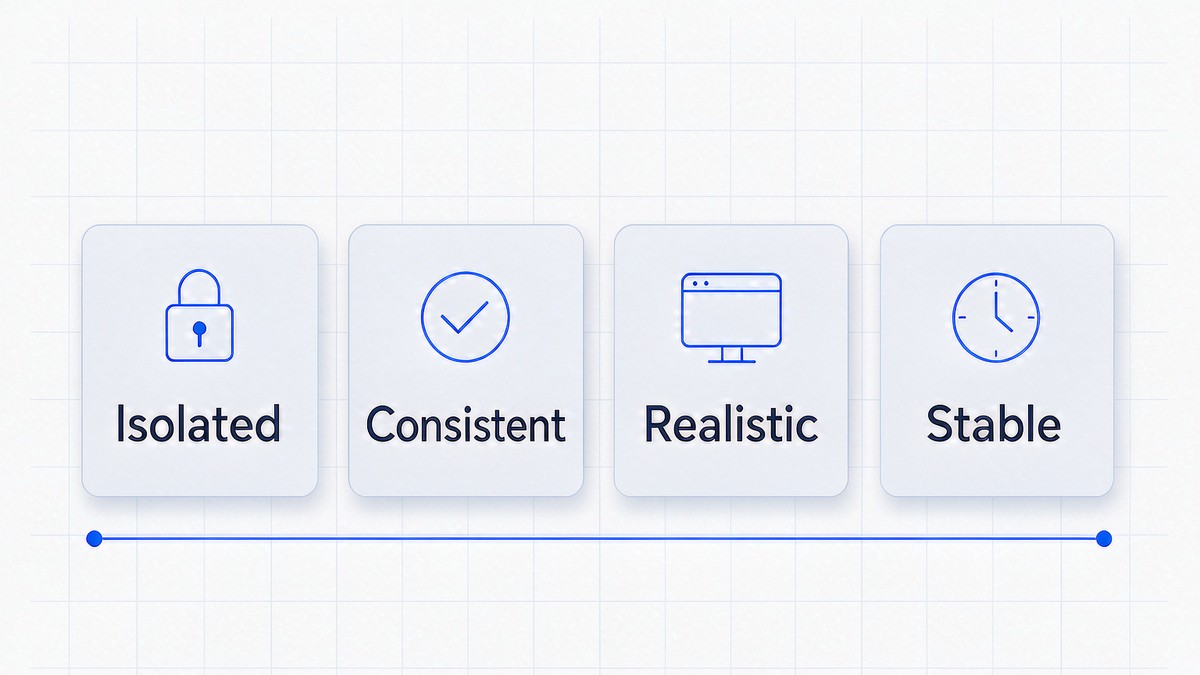
Independence, consistency, realism and stability. The official site compresses them into one line: profiles stay independent of each other, and the signals inside a profile stay logically consistent. It sounds like a slogan, but pulled apart it names four concrete failures. Storage shared across accounts, signals that contradict one another, combinations that look assembled by hand, and an identity that drifts over months. Each principle stops one of them, and the four also push against each other.
What Each Principle Blocks
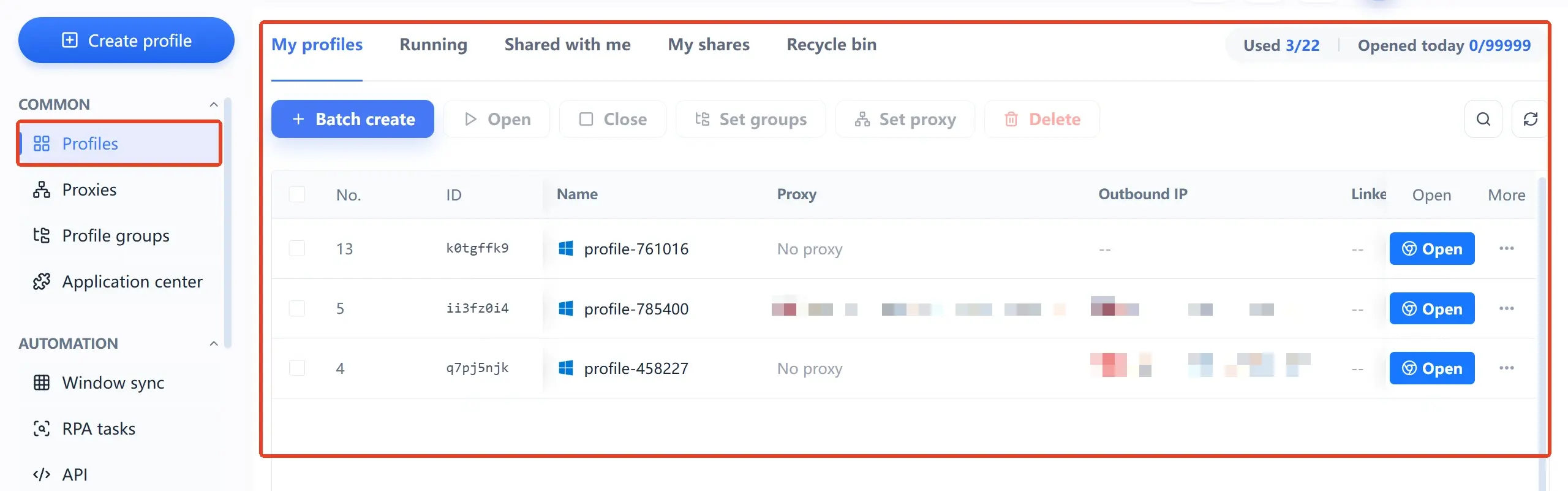
Independence governs boundaries. Cookies, local storage, IndexedDB, sessions and cache for one profile have to belong to a single account as a whole, and fingerprint and network settings are managed per profile too. The part people misread most often is the proxy: proxies are configured separately, and two profiles pointed at the same proxy still present one public IP to the outside. Isolating profiles does not by itself give you different exits. The official site states this plainly, because it is the detail beginners skip.
Consistency solves the explanation problem, and it is the costliest of the four. Operating system, User-Agent, GPU, WebGL, Canvas, screen, time zone, language and IP cannot contradict each other. Windows paired with a graphics card that only ships in Apple machines, a US IP with an Asia/Shanghai time zone, a 390×844 phone resolution on a 1920×1080 desktop. Every value is legal on its own, and assembled they describe a machine that does not exist. The reverse is not automatically wrong either, and the official site leaves room for that: an unusual combination may still have a reasonable explanation, and the comparison chart shows how to check rather than what to avoid. Internal coherence is the standard.
One more layer is easy to miss: the extensions installed inside a profile. An extension injects its own interfaces, fonts and styles into pages, so a group of profiles with a comparable set installed looks fairly close to the same thing from the outside. The app centre in the management panel installs extensions per profile, and that is best held consistent the whole way through rather than added today and removed tomorrow.
Realism is about where parameters come from. A profile has to follow the logic of real devices and real browsers instead of mixing parameters at random. Randomization carries an unspoken assumption: the rarer the value, the smaller the chance of a collision. A real computer used for years keeps its system version, GPU, fonts and time zone inside a range, and a rare combination built by force is harder to explain, not easier.
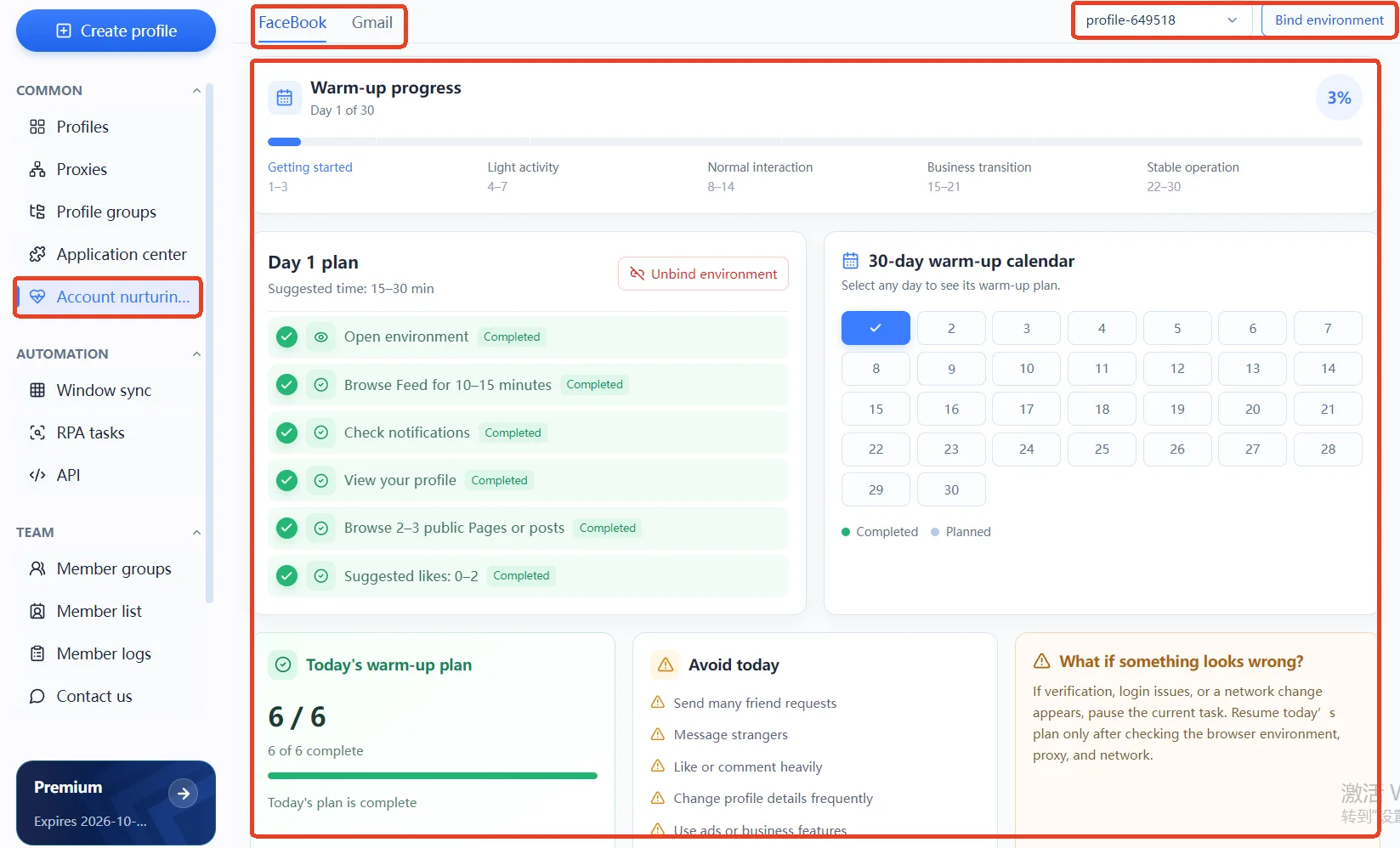
Behavioural rhythm falls under this principle as well. The account growth plan, what the trade usually calls warming up an account, splits the first month into five stages: initialisation, warm-up, normal interaction, business activity and self-directed operation, and lists a few suggested actions for each day, such as opening the profile, going through the feed once and replying to a backlog of notifications. Beside it sits a list of what not to do: continuous heavy interaction, marketing-style posts, comments copied in bulk. That list is worth more than the to-do side.
Stability constrains the timeline. A profile's core digital identity should stay reasonably stable over months rather than being regenerated on every launch. Andriamilanto and colleagues counted roughly four million real browser fingerprints in 2021, and more than 90% of the attributes were unchanged six months later (the figure comes from this systematic review of fingerprinting research). Real devices hold still more than most people assume, which is also why swapping identity every day looks unnatural.
Stability does not mean nothing can change. Browsers update, proxies drop offline, sessions expire. In the management panel, logins, actions, and the sharing and transfer of profiles all leave records. When something genuinely goes wrong, walking back through those records is far quicker than guessing from memory who touched what. To see whether those changes are heading the wrong way, run through account health once a week; it gathers the status of several back-office panels in one place.
The Hard Part: The Four Principles Push Against Each Other
Independence and consistency pull in different directions. Tune every profile to be different and independence is satisfied while consistency may break: a User-Agent and a GPU that were a matched pair inside one profile now describe a combination nobody owns once you replace one of them.
Realism and stability restrain each other too. The real world moves. Browsers ship a major version roughly every four weeks, systems push feature updates, and demanding that a profile never move contradicts reality. The official wording is that the core digital identity stays reasonably stable, while acknowledging that browser updates, expired sessions and deliberate network changes still happen. When a change is genuinely needed, check the related settings together.
Efficiency and consistency clash as well. Window synchronisation aligns the input of several profiles, so one click takes effect in several windows at once; bulk operations and automation flows do the same job, taking repeated actions off your hands. The time saved is real, but it is worth seeing clearly that what gets synchronised is the action, not the identity signal. Conversely, mixing windows with different operating systems and different resolutions into one group for the sake of speed means some actions will not land in some windows, and the action itself becomes the anomaly. Grouping profiles with similar configurations costs less effort than picking a few at random.
When the four conflict, the order to judge them in is: first make sure it holds together, then ask whether it is distinctive enough, and only then talk about holding still. Consistency is a hard constraint, and a self-contradictory set of signals fails no matter how rare it is. Independence is a boundary, and one account per profile is not negotiable. Realism and stability are matters of degree, and trade-offs are allowed.
Turning Consistency Into Something You Can Check Item by Item
The browser profiles section of MostMate's official site splits browser identity into three layers: the device layer holds the operating system, the GPU and the screen; the browser layer holds the User-Agent, WebGL and storage; the network layer holds the IP, the time zone and the language. None of the three means anything on its own, and the test is whether they can explain each other. The site also says something easy to scroll past: the consistency comparison shows how to inspect, not how platforms detect. Mixing those two up sets expectations a tool cannot meet.
For the actual work, this order holds up.
- Set the network layer first. Choose the proxy and the region before anything else, because they decide what the time zone and the language should say. Picking a time zone and then hunting for a proxy usually means redoing the work.
- Then the device layer. Once the operating system is fixed, the GPU model, screen size, memory and CPU core count have a reasonable range, so stay inside it.
- The browser layer closes it out. The system and browser versions inside the User-Agent have to match the device layer, and the renderer name WebGL reports has to match the GPU model.
- Cross-check the three pairs that fight most often across layers: User-Agent against GPU, IP against time zone and language, screen size against device type.
- Retest a week later. Run the same profile through a public checker such as BrowserLeaks and compare whether the key values have drifted.
The first pass takes about twenty minutes, slower than changing a few parameters at random. What it buys is a configuration you can explain. When something does break, you know which layer to check first. Picking a proxy usually eats half of that time, and there is no shortcut there.
Three Misreadings That Keep Coming Back
- Treating the four as four switches. Change the User-Agent without touching the GPU and consistency breaks on the spot.
- Treating extensions as neutral. What a plugin injects into the page is something few people look at before installing it, and in a group of profiles where some have it and some do not, the difference shows up.
- Reading stability as never changing anything. Stability means the core digital identity should not change without reason, not that every legitimate update is refused.
What the three have in common is treating the principles as a one-time setup step. They describe an ongoing state, not the boxes you tick when a profile is created.
Keeping It All in One Workspace With MostMate
MostMate builds a profile on four layers: device identity, browser identity, storage isolation and network environment. At creation the system offers a recommended configuration for your platform and region, and that default set is assembled for consistency; finer adjustments to language, time zone and device parameters live in the advanced settings. It does not make the judgement for you, but it settles where the parameters come from. To see the wider picture first, read what the MostMate fingerprint browser is.
Once several people are involved, the boundaries still have to hold. Profiles can be sorted into groups, and groups authorised to specific members; logins and actions all leave records, so who touched which profile and when can be traced afterwards. For the overall picture, the introduction to what the MostMate fingerprint browser is, linked above, is the place to start, and the MostMate blog gathers more topics of this kind.
To get familiar with the logic of how a profile is built first, you can walk through the setup preview without registering, and the download page lists the supported platforms too. See how MostMate organizes browser profiles and multi-account workflows

Frequently Asked Questions
Which of the four principles matters most?
Consistency. Independence, realism and stability all allow trade-offs. Consistency does not.
Do high scores from a detection tool mean all four are satisfied?
Not necessarily. A tool gives you a snapshot from one moment. It cannot see whether two profiles share a proxy, or whether you will change the parameters next month.
Do I need to rebuild a profile after changing the proxy?
Usually not, but the related items should be reviewed together. If the exit country changes, the time zone and the language are better adjusted with it, or the network layer and the browser layer stop matching. Retest a week after the change.
Can the actions in the account growth plan be handed over to automation entirely?
Handing all of it over is not advisable. Automation suits the repetitive part where judgement costs little, such as browsing on a schedule or entering a profile on a rhythm. When to stop and what to publish still need a person. The list of things not to do in the plan exists to be read by people; a program will not judge the measure for you.
Are the four principles the same thing as avoiding detection?
Two different things. The official site states clearly that the consistency comparison shows how to inspect, not how platforms detect. Making a configuration coherent gives a profile a reasonable explanation. It does not mean a platform cannot see you.